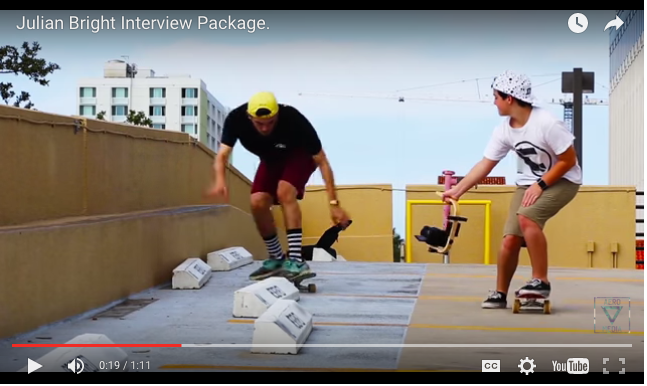
When grading your video projects, I base most of the grade off of whether you had a wide variety of shots (at least one extreme close-up, regular close-up, medium, wide, high angle, low angle, over the shoulder, etc.).
You are most likely to get points taken off if your interviews are not framed well (ex: if there is too much headroom or not enough lead room). Also, if your interview is not lit well or backlit, that will cost you more points.
I’m a huge fan of nats pops, so the more nats you use, the better your grade will be.
At the beginning of the semester, I will base most of the grade on if you have the technical skills to use your camera, edit software, YouTube and WordPress. As we get closer to the end I ask questions like:
Is this video airable? Does it look professional?
Is this story compelling enough to broadcast on my newscast?
Would I suggest you use this video on your resume?
If I answer yes to those questions, then you will get an A.
I also suggest you ask yourself these questions before you submit your projects:
Is there value in this for viewers?
If I spotted this video on social media, would I share it?
If someone sent me this video, would I watch the entire thing?
Would I watch it more than once?
Here are examples of how other USF students completed the projects in this class
Microblogging: Short message postings from a social media account. Facebook statuses and Twitter posts are two examples.
Meme: A means of taking viral concepts and making them everyday lingo. Check out “Know Your Meme.”
Gif: Graphics Interchange Format. GIFs are image files that are compressed to reduce transfer time. Though the “correct” way to pronounce it is with a soft “g” like “jif,” so many people use a hard “g” that it’s become acceptable to say it both ways. There are now gif keyboards for your phone, gif buttons on social media, and sites like giphy where you can copy embed codes and share gifs.
Engage: Don’t just post information on social media, share, comment, like, reply and interact.
80-20 Rule: Use 80% of your posts to add something of value to the community. The other 20% can be self-promoting.
RT: retweet. Sharing another person’s tweet on your own Twitter timeline.
DM: Private direct message on Twitter.
@: This always goes in front of a Twitter user’s handle/user name and is called “at” in broadcast news scripts.
Hashtag: A “word or string of characters that starts with #. Identical hashtags are then grouped into a search thread.
Watch this video about engineering the perfect gif because gifs make the social media world go round.
Social Media Guidelines
Most news organizations have specific guidelines or style guides for how employees will use social media. Here is one from NPR: http://ethics.npr.org/tag/social-media/
Treat your social media accounts like every future employer will see everything you’ve ever posted. Before you post, think about if it makes you look better, or worse. If the answer is neither, then it won’t help your personal brand and it won’t add value, so the answer is worse. Your social accounts say a lot about you. Make sure you’re sculpting your social media image with professional, objective and valuable posts.
It can be a valuable tool for finding sources, finding ideas early, tracking and connecting with the community and following breaking news.
Twitter
If you’re brand new to Twitter, here’s a tutorial on how to get started:
Looking to step your Twitter game up a bit? Here’s how to improve your profile and how to use Twitter for journalists:
Mashable has a great list of links that help you create a Twitter profile and tips to increase your search engine optimization and engagement: http://mashable.com/guidebook/twitter/
Twitter Search: Make your searches pointed and try different combinations of words and spelling if you have a specific topic in mind. Use advanced search by location to make sure Tweets are locally relevant. For example, here’s a search for “medical marijuana” near Los Angeles: http://bit.ly/QxPCh6. You can also search what people are saying about a story you’ve posted by searching the url of the story.
Twitter Lists: Use Twitter lists to find people that are local and talking about topics that you are covering. Use your own Twitter lists, and check other Twitter accounts’ lists as well. Find out more about Twitter Lists in this helpful FAQ.
If you want to keep your followers, follow them back and engage in their tweets by liking, retweeting or creating a dialogue. The fastest way to get followers on Twitter is to follow people with similar interests and unfollow them if they don’t follow you back. I suggest going to one of your favorite twitter profiles that you follow like @BuzzFeed for example. Then click on the link that shows their followers, I’ve highlighted it below: Then follow their followers. After a week or two, go back to your list of people who you follow and unfollow anyone who isn’t following you back. Note: avoid following people without profile pictures because they could be fake and leave you open to getting hacked. Also, avoid following anyone who may make you look bad if your future employer checks who you follow.
One of my favorite tools is TweetDeck. It’s incredibly helpful for journalists. It helps you quickly consume and share information.
You should also use TweetDeck to schedule posts when your target audience is most active.
Social Example
Lindsey Mastis is a great example for anyone who wants to become better at social media. She used to work at Tampa’s NBC affiliate WFLA. She moved to Washington, D.C. in 2016 and now works at WJLA Check out her Facebook Live videos to go behind the scenes of a news station. And follow her on Twitter.
Search YouTube and filter by upload date to give you the most recent searches. For example, here’s a search for “hurricane sandy new york” filtered by upload date.
Think about news happening in your local area right now and be pointed with your searches. For example, if there’s a protest happening in downtown Boston right now, you might search “protest Boston” and filter by upload date.
Advanced Tips: Learn more about searching YouTube for local news videos in this webinar.
So how does YouTube actually work?
Facebook
Facebook is taking on YouTube as it shifts its focus to video.
There are over a billion people on Facebook sharing updates full of possibilities for stories.
Facebook Public Posts: You can often search public posts on Facebook. You can search via sites such as whotalking.com or adding site:facebook.com to a Google search.
Facebook Groups: Search Facebook groups to find local conversations and sources, too.
Facebook’s new trending section: a great way to find viral stories for a newscast or blog.
Facebook Live: Facebook live is becoming a popular tool for journalists. Most news organizations now regularly go live on Facebook to increase their analytics and engagement. Facebook live is a great way to get questions and comments from news viewers and respond live. It’s also great for emergencies like hurricanes. This way people can get live video updates even if the cable goes out. Here are some best practices. RTNDA shared 5 tips for journalists to maximize Facebook Live.
Here’s an example of how WFLA used Facebook Live to reach people without power or cable during Hurricane Irma. The anchor and meteorologist answered questions that viewers posted in the comment section during commercial breaks and even during sound bites as they broadcast their newscast live on TV.
NPR also uses Facebook Live to give their audience a behind-the-scenes look at newsgathering and storytelling.
Facebook Live is also proving to be a popular tool to document things like police shootings. For example, Philando Castile’s fiance made headlines when she live-streamed his death on Facebook. This evidence will now be used in the trial. Some corrupt law enforcement officers have been found to delete or tamper with cell phones after people record them committing crimes. Facebook Live is automatically posted on Facebook. Therefore many are touting its ability to create more transparency in the criminal justice system.
Check out local companies. Updates from all employees affiliated with the company will show up here, so you can see any updates about who has joined a company or recently left. You can also see job posts, so you can track if there are any big changes coming.
LinkedIn features top 120 professionals, 35 and under in a great initiative called Next Wave. Check out who they think you should follow.
Reddit
Reddit is a big online community made up of many smaller communities. There is a lot of everything on Reddit and most of what you see will likely not be of journalistic value to you. But there are gems that can lead to story ideas and news tips.
Look for Reddit communities by searching: reddit.com/reddits/search or by guessing. Every Reddit community can be found by finishing this URL: http://www.reddit.com/r/_____. Check out what people are talking about in your area’s Reddit community, and don’t forget to check out the comments on the posts for additional story idea fodder.
Here’s a fun trick: you can see what stories have been shared from your site on Reddit by putting your url in the blank: reddit.com/domain/___, for example:reddit.com/domain/npr.org.
Yusuf Omar is one of the leaders in the selfie journalism revolution. As the Mobile Editor at the Hindustan Times, Omar is building the world’s largest mobile journalism team. He’s training journalists to create faster content using mobile devices. But more importantly, he’s using mobile devices to tell grassroots stories that otherwise wouldn’t make it to mainstream media.
In 2016, Omar won the world’s first Snapchat awards for giving a voice to sex abuse survivors. His use of social media and new technology is an inspiration to up and coming journalists. It’s cheaper, faster and desperately needed content.
Please watch this News Xchange discussion about the future of news. Omar explained how he curates social content to tell stories in a more democratic way. Traditional journalists challenged Omar in the discussion portion after his talk. As a journalist who’s worked for both traditional newspaper and television news in America, I understand where the old guys are coming from. But I think it’s time we recognize the cracks that are deepening in traditional news workflow.
I am not alone in longing for the days when journalists actually had time to research and create valuable content. At the end of the day, news companies are businesses, so it appears journalists will continue to grind out a higher quantity and I fear the quality will inevitably suffer irreparably. So let’s listen to Omar, because he may hold the only key to maintaining the journalistic ethics we’re all clinging to.
Snapchat is a little less user-friendly so I encourage you to watch this tutorial for beginners:
Storytelling is becoming interactive. We've spent ages trying to create thumb stopping content so people didn't scroll past our videos on crowded timelines. Now it's about creating thumb engaging content like the Stories format on Instagram and Snapchat 2/3 #TheWholeStory
News organisations are quick to dismiss new technologies as being gimmicky or frivolous, without seeing the potential to do better journalism.3/3 #TheWholeStory
Yusuf Omar and his wife Sumaiya Omar spoke about the evolution of mobile journalism
MOJO 101 video by Yusuf Omar
Instagram
Instagram is a great way to showcase your photos and videos. But it’s also being used for news. The BBC was one of the first large news organizations to really invest time in creating Instagram videos to inform viewers and promote their longer news stories.
An incredibly engaging and efficient person to learn from calls himself “Lazy Ass Stoner.” He has dozens of helpful videos and hundreds of thousands of views. In the following video he goes over three viral marketing strategies:
The Viral News Story: This technique involves finding ‘hot’ and popular viral news stories that are related to your niche and then re-writing them, posting them to your blog and then posting them out through all of your social profiles.
The Viral Video: When many people think of ‘viral video marketing’ they think of pouring thousands of dollars into creating the perfect viral video and they just *hoping* that it goes viral but with this technique you’ll be able to simple leverage other people’s viral videos to drive tonnes of free traffic to your blog.
The Viral Infographic: Infographics are insanely viral and they are a great way to score easy, free visitors to your site. This technique involves simply finding niche related infographics and then posting them onto your site and then out through your social channels.
Periscope was one of the first leaders in live streaming apps. Now, you can stream live on Twitter, Instagram, YouTube and Facebook Live.
In 2015, Apple named Periscope the iPhone App of the Year. Twitter acquired Periscope, helping the app beat out another early live streaming app, Meerkat. It is now integrated into Twitter’s main app. Periscope users can tweet out a link to their live stream.
Social networking sites have become an important additional arena for politics. They are a resource for political news, information, finding like-minded issue-oriented people, and a tool for voter outreach in the run-up to elections. During the 2012 campaign season, Pew Internet released a number of reports on the role of social networking sites on elections and the political process:
Vadim Lavrusik (author of the FB search tutorial) is Facebook’s person in charge of developing FB products targeting media and journalists. Follow him here https://www.facebook.com/journalists.
A great producer always asks themselves one question about every story they choose to air… who cares?
A great producer can quickly sift through hundreds of headlines and videos every day and pick out the ones that matter to their viewers.
This doesn’t mean that every story is profound. Every show needs balance. A great producer gives their audience a good balance of emotions. A balance of emotions does NOT mean emotionless. Apathy is not the emotion you want to evoke in any audience. But, you also don’t want to take viewers on an insanely erratic roller coaster ride. A great producer strategically plans how they will affect their viewer’s emotions from the beginning of the show until the end.
A great producer understands their audience demographics and adjusts the story choice and writing style accordingly.
Producers at WFLA
Blocks
Newscasts are separated by blocks. The first segment of the show is called the “A-block.” The first commercial break airs at the end of the A-block. Then the second segment is called the “B-block.”
Every station has a different show wheel for each show. Show wheels indicate how many blocks and breaks air during a newscast. It also shows how many minutes of commercial breaks air in the show.
Most blocks in live newscasts fluctuate slightly in time depending on the content. Some stations pre-tape blocks of their news. In this case, they may have hard times.
Producers create template rundowns with their blocks and breaks which will generally stay unchanged. Each day, a producer starts their day with a blank rundown (this includes break times and blocks). The producer is responsible for stacking the rundown with enough stories to fill their newscast.
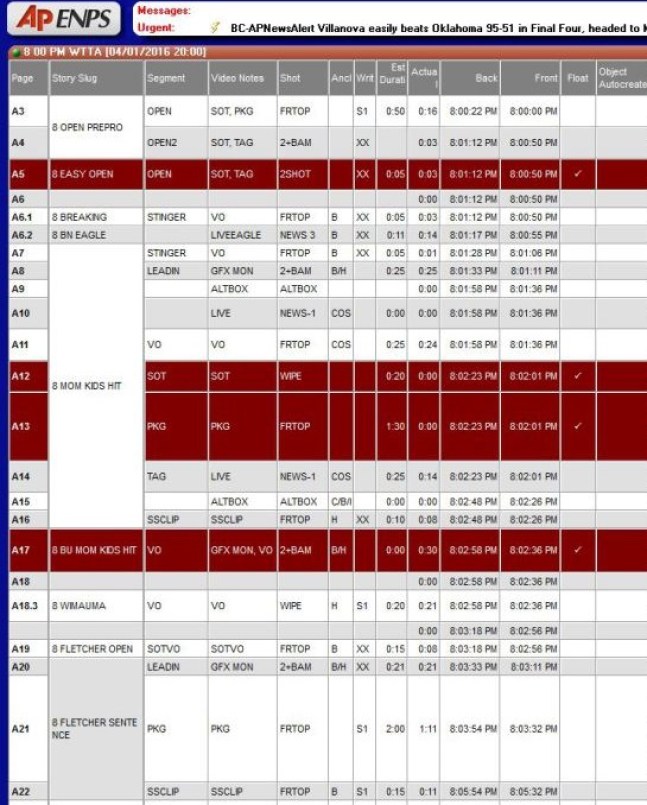
Why Lines Are Highlighted In Red
In ENPS the red lines signify the producer floated the story. Float=skip. This means the script will not show up in the teleprompter, the video and graphics will not be queued in the automation system Ignite.
A producer chooses to float stories for different reasons:
To cut time from the show. Floating a story will help if a show is over or heavy. A show gets heavy when:
too many stories are added
anchors/reporters/meteorologists adlib for too long
another program leading into your show goes long (this usually happens during sporting or live events)
To keep backups in the rundown and readily available in case of an emergency like a live shot failing, or a reporter not making it in time.
What TV News Looks Like To Viewers
Here’s an example of an A-block I produced for News Channel 8 at 8 on Great 38. This is what viewers see:
How It’s Made
Here’s the ENPS rundown that shows how I formatted the A-block to communicate what I wanted the show to look like with my editors, floor director, technical director, director, anchors, reporters and camera operator:
Open Script
Here’s another example of a show I produced. Watch the newscast and follow along with the rundown to better understand formatting.
NOTE: the yellow highlights on break 3 and final weather represent the timing bar. Since my show was an hour, it’s broken up into two separate half-hour rundowns. The producer hits the space bar and the yellow timing bar moves through each page in the rundown to help time the show.
Here’s another example of a show I produced, notice how the show matches the rundown:
Here’s another example of a show I produced, notice how the show matches the rundown:
How It’s Made
NOTE: During this newscast, I move the scripts for A44-A49 into the C-block because my live shot in A23-A29 went long. Most live newscasts are rated using Nielsen boxes. These boxes record how long people watch different channels and at what time. Ratings are measured in 15-minute increments. Producers don’t want viewers changing the channel, which is why writing great teases is so important. Depending on who you work for, you may be required to start your C-block at 15-minutes or 45-minutes past the hour to improve your ratings. So, A44-A49 are in the C-block because if I would have left those scripts in the A-block, then I wouldn’t have started my C-block until 09:16:40 a.m.
So how did I move the scripts during the live show and not mess up the newscast? I floated A44-A49 when I realized my A-block would be heavy. This caused ignite, my directors and anchors to skip those scripts smoothly. When we got into the first break, I told my directors I wanted to move A44-A49 out of the A-block and into the C-block. Then I highlighted those lines and dragged them into the C-block. I unfloated them and told my anchor we were resurrecting the scripts from A44-A49. When you look at the estimated duration column, you can see A44-A49 is 1:40. So to adjust my overall show time, I floated/killed the traffic donut in C1-C3 that was supposed to be 1:17.
Election Night 2016
Election coverage is notoriously the most challenging show for a producer, especially if their show is airing live as election results come in. I produced this newscast at 8 p.m. on election night in 2016 when polls were closing across the country. This meant I had to prepare for anything and everything to change, and it did.
This newscast was unusual because we usually begin at 8 p.m. on WTTA, but on election night, we simulcasted cut-ins on WFLA. So the A-block would usually start on A1, but since we aired a cut-in in the same rundown at 7:45 p.m. my A-block begins on page A26.
Also, note that this one-hour newscast is stacked in two half-hour rundowns because there’s so much content that the system would have a difficult time loading changes if it were in one rundown. Because of this, you will see the first half-hour ends after page D26. Underneath the black line, notice how I kept concession and victory speeches ready to go, so I could just drag them into the rundown when those occurred. Producers should always prepare breaking/election news templates under the black line so they can get them on air faster with little or no notice. This also helps directors code ahead of time so the automation system, Ignite, can adjust to changes faster.
The second half hour was very fluid so you’ll notice I floated much of what was originally planned. I also moved a few page numbers around to adjust to the breaking news. Because of the number of last-minute speeches, I skipped a three-minute commercial break and ended up airing it at 9 p.m. to make room for the election coverage. Producers should always get permission to move breaks out of their designated hour from a supervisor since these breaks contain advertising money.
A28 is floated just in case my pre-produced open wasn’t edited in time.
Here’s the ENPS rundown that shows how I formatted the 2016 election show.
Consumer News
I produced the 7 p.m. show that aired on WFLA 12/09/15. This show is big on consumer news so I chose a couple of blocks to showcase different ways to tell consumer stories. I put it together very quickly so there’s a lot of room for improvement. For example, there’s too much file video and would be better to use specific images.
Police & Periscope Tease, Toss, PKG & tag
Rundown
Tease
Toss/Lead
PKG script
Tag
Look For Opportunities To Use Sound
Here you see a story about Adele with a nat pop in the tease SOTVO, then a longer SOT in the story airing in the C-block.
Rundown
Tease
1shot, sotvo script
Don’t be a lazy producer
Example of a lazy script:
What’s wrong?
The VO is way too long.
File video is not necessary when new video exists.
It’s not new, now, next.
The new element is added in an on camera tag.
The producer was lazy by doing an on camera tag instead of showing the Instagram post
The script is not written to video
How to make it better
New, now, next.
Script written to new video.
Video credited to fans.
Social media response both written and shown on air.
The writing is tighter/concise.
Writing Lower Thirds
Lower thirds are also referred to as "supers."
Avoid some acronyms in graphics like the World Health Organization:
Lower Third Examples
Tease lw3
Subject 2 line lw3
Name lw3
Writing to Video
How This Story Was Teased
Speed
Speed is a crucial skill a producer must have nowadays. There is no way a producer knows 100% of the stories in their show. News producers must educate themselves on a wide range of topics quickly. The faster a producer can do this, the more time they can spend crafting their scripts and being creative.
Tips For Producers
Learn how to search for things on the internet.
Use control+F to find keywords.
Use the “most recent” filter when searching for the latest information.
Learn how to skim a story to get the most important information at a glance.
Learn how to write quickly
You need to know what good writing is and what bad writing is.
The more you read other people’s scripts and watch other people’s shows the more you ingrain a gut instinct of what is good or bad.
Write a lot. The more you write, the faster you become.
Work smarter not harder.
Create script templates so you don’t rebuild every script from scratch.
Keep breaking news templates readily available and coded under your rundown so you don’t waste time formatting when trying to get breaking news on the air.
Watch/listen/read news before you come to work so you have an idea of what may be in your show before you get there.
Always keep a list of teaseable stories in your notes on your phone.
Find your go-to websites that you know will give you good story ideas.
Know what aired on your station when you weren’t there. If you work evenings, watch the morning show, or log on to the content management app (like iNews or ENPS) to go through their rundowns before you start your shift.
Follow your competitors on Twitter.
Next Level
Being a great news producer means more than putting a clean show on the air and getting all the information right without typos. Being a great producer means building your show in a way that evokes emotion and makes people want to keep watching. Two massively underutilized tools in a producer’s belt are promotions and teases.
Promos get viewers to tune in. Teases keep them watching. Promos air during commercial breaks. Teases air during the newscast. The promotions department writes promotions. News producers write teases.
If you haven’t already read the promos and teases lecture, do yourself a favor and head on over to the lecture to learn how to write concise, creative and specific teases.
Promos
Just because promotions departments are responsible for creating promos, doesn’t mean the producer should just focus on the newscast. Producers must collaborate with the promotions department so they can be better at their jobs.
News Producers are really the only ones who can see the big picture in their show. Most promotions producers will look through a rundown halfway through the day. Depending on a producer’s workflow, a half-done rundown is rarely the best representation of how the show will turn out. Give your promotions people a hand by emailing them your most promotable stories as early as possible. Send them video and tell them how you plan to tease the story. Make sure the promos and teases compliment each other, not just repeat.
News producers should also ask the promotions department if they’ve seen any cool stories that should be in the show. When news producers and promotions people work together it results in more effective promotions and boosts ratings.
Teases
If you want to be a great producer, great ratings will help you get attention from the bosses. How do you get great ratings? Teases are the most powerful element producers can use to keep viewers watching.
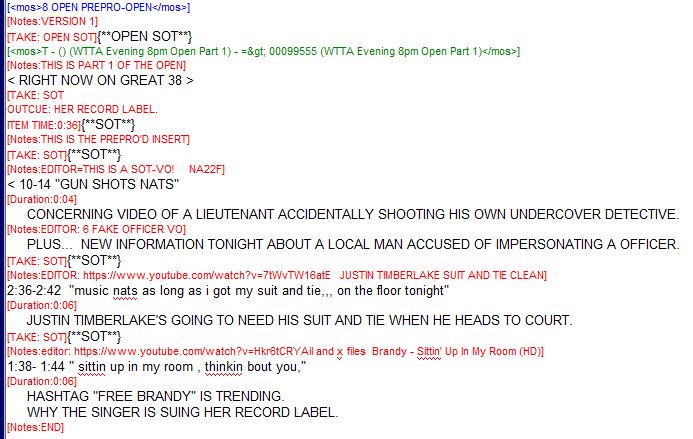
Use your show open like a tease. Pre-produce your open. That means picking at least a few sound bites from your stories and having an editor cut a package showcasing three stories coming up in your show. I suggest choosing your lead story, then two other talkers. I’d tease your b-block story and deep tease a story later in your newscast. This way viewers will stick around if they know you have great stories coming up.
Here’s an example of a pre-produced show open:
Know when to break the rules. If you’re leading with a terror attack, then focus your entire open on that one story. I know your executive producer may not like it, but I encourage you to fight back on this one. Viewers watch your show from a very different perspective. TV news journalists often fail to see how insensitive they’re being by promoting and teasing happy stories right after devastating ones.
Violence will likely be part of every newscast. But some acts of violence are so big they warrant more caution. Your executive producer will likely want you to stick with consistent show open music for branding. However, in this instance, please don’t hesitate to use more appropriate music. Here are two examples of when I chose not to include other stories in my open because the attacks were the only stories that mattered that day:
When you deep tease, don’t forget to remind viewers about it in another tease, preferably the tease immediately before the story airs.
If your boss lets you, pre-produce your teases too. Add some music and sound bites to pick up the pace and set the tone.
Break the rules the right way. It’d be great to tease three stories in each tease, but sometimes going big on one story in a tease is more powerful. I know you’re under pressure to write super short teases so you can increase your story count. Many executive producers will give you about 10 seconds per story in a tease. But sometimes spending time in one story tease is worth the return on your investment like this:
Ask your reporters to shoot standup teases, then produce them. This will stand out next to those monotonous and boring newscasts you’re up against in the fight for ratings. Don’t just air a standup tease by itself. Add flare like a nat pop and some b-roll with a pre-produce announcer open and close like this:
Maps
Don’t make this common producer error:
Maps can be incredibly helpful in telling a story like this. But if you don’t include major interstates, you’ll leave viewers concerned and confused. So is this in their neighborhood or not?
An animated map that starts wide, then zooms in is more helpful. The zoomed in map includes major streets and interstates.
Show Wheels
Another way to step it up is to adjust your show wheel. A producer (or executive producer, assistant news director, news director) will adjust a show wheel in hopes of keeping viewers watching longer.
One show wheel adjustment I made in San Diego was to create seamless transitions from the lead-in show. Especially if your lead-in show is primetime, producers can carry over more viewers if they start their newscast immediately after the primetime show ends.
The challenge is the commercials need to go somewhere. That means newscast breaks either need to be longer, or a producer needs to move the break to another spot in the show, creating an additional block. You must weigh these choices, but I think stealing those primetime viewers is better for evening shows than losing a few viewers during longer or more frequent breaks. This method is not as effective in morning shows.
Here is an example of a show wheel suggestion I made at WFLA. I have to preface this with it’s my opinion. This is not necessarily right or wrong because every newscast is adjusting to different viewer habits and different lead-in and lead-out programming.
Instead of trying to squeeze two blocks in before my quarter hour, I made the A-block longer and kept my viewers watching through the quarter hour in a B-block. This improves my chances of getting those viewers in both quarter hour Nielsen ratings.
To keep viewers watching through the second break, I added a 15-second tease in the middle of the commercial break.
Don’t you hate when you sit through a break only for the anchors to just say goodbye? Viewers do too. If you have a good lead-out show they will stick around to watch the show that airs after your newscast, so add a break at the end of the newscast instead.
Grabix
Talking about Nielsen, great producers know how to interpret Grabix reports. Great producers know how to read between the lines and adjust their newscast accordingly.
If you want a producer job, you’ll likely have to write at least one show critique as part of your interview process. Here are two show critiques I wrote before I was hired at WFLA:
Learn what you like and what you don’t like. Develop your style.
Check out how two different reporters and videographers told the story of Robby Heil, a special needs boy who made a touchdown as his mom with cancer cheered from the sidelines:
Rod Carter shot this pkg entirely on his cell phone and iPad. It shows how basic principals greatly affect the look of your pkg. Check out the different angles, heights and distances he uses. Listen for the nat sound.
Active Reporter Standups
Active standups are just as important as shooting a variety of b-roll shots. Thinking of active reporter standups can be challenging when you first begin. It can be particularly difficult when you are an MMJ and don’t have a photographer to help you. Joe Little is known across America for his creative standups. Watch this video to see how he shoots and edits them all by himself.
Be Creative
Jeanne Moos is a great reporter who always creates entertaining pkgs. She uses news stories, music and file video in clever ways.
Lately, most of her pkgs are political parody because of the presidential race, but she has years worth of pkgs on every topic imaginable.
I encourage you to search her on YouTube and take inspiration from her:
writing
sound bites
music
social media
b-roll
quotes
editing
active stand-ups
NOTE: if you use b-roll like her, make sure to also note how she uses courtesy bugs on video she didn’t shoot herself.
Look for journalists who inspire you and give you ideas for your own stories. CBS has an incredible series called “On The Road With Steve Hartman.” I embedded their YouTube playlist below and I encourage you to watch a few of his stories.
What makes a pkg good or bad?
Watch the following packages on a high school football player who died.
Do you think the reporter, videographer/editor did the story justice?
Do you feel emotionally moved by either version of the story? Why or why not?
Pay attention to how the poor video composition and wallpaper video distracts you from the point of the story.
BREAKING DOWN PKGS
Turn a PKG into a VO
Turn a PKG into a VOSOTVO
Use what you’ve got to make it interesting:
Notice how the reporter and editor use file video.
You are going to be responsible for sculpting what journalism becomes, so be ahead of the game and stay on top of emerging technologies and trade news.
I suggest bookmarking these sites, subscribe to email updates and/or download apps for push notifications.


 Then follow their followers. After a week or two, go back to your list of people who you follow and unfollow anyone who isn’t following you back. Note: avoid following people without profile pictures because they could be fake and leave you open to getting hacked. Also, avoid following anyone who may make you look bad if your future employer checks who you follow.